
For a permanent system on a home you own, wired cameras are the better choice. Wireless cameras have a place too, mainly in rentals and in spots where a cable cannot reach, but they often get sold for jobs they handle poorly.
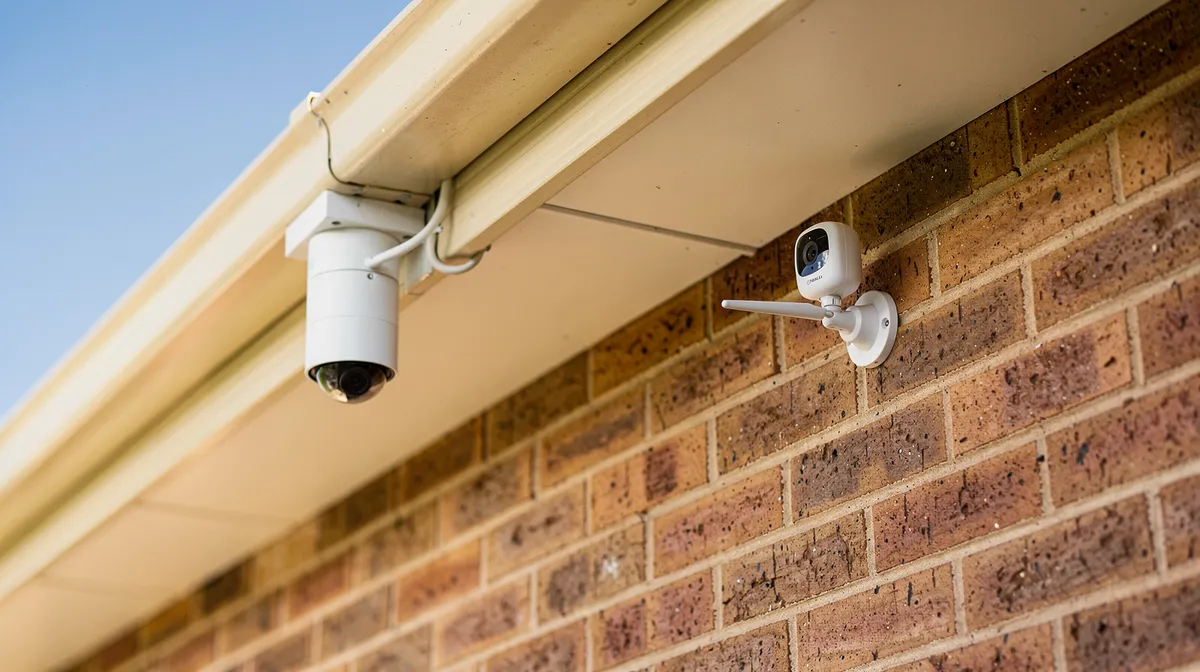
People talk about wired and wireless as if there were two choices. There are really three, and most of the confusion comes from treating the last two as one. A wired camera uses one Cat6 cable for power and video, run back to a recorder. A wifi camera sends video over your home network but takes power from a plug nearby, so it still has a cable. A battery camera has no cable at all, records short clips when something moves, and has to be recharged.
The single cable is the advantage. Power travels down the same Cat6 as the picture, so there are no plugpacks hidden in the roof to fail and no second power supply to track down when a camera goes dark. The camera can record around the clock at full resolution and frame rate, because it is not saving battery or sharing bandwidth.
Your wifi does not come into it either. In a house with several phones, tablets, laptops and a smart TV, the wireless network gets crowded, and video suffers first. A wired camera records at full quality however busy the network is, and carries on if the internet goes down.
The cost is in the installation. Running Cat6 through the roof, down a wall cavity and out behind each camera takes time, and it is most of what you pay for. It is also the part of the system that lasts fifteen years or more.
Indoors and close to the router, a wifi camera can be the easy choice it is sold as. On the outside of a brick home it is a different story.
Brick, render and roof tiles all weaken a wifi signal, and the far corners of a house often get the worst reception on the property. A camera on a weak signal skips frames, freezes at the moment you need it, then catches up when it is all over. That is not a faulty camera. The signal simply cannot get through.
Power is the other catch. Almost every wifi camera runs from a plugpack, so unless an outdoor power point happens to sit right where the camera should go, an electrician has to fit one. Once that is paid for, a wired install often costs about the same or less, and works better.
A battery camera can go up in a few minutes almost anywhere, with no cable and barely a hole. That makes it handy in a rental, on a temporary site, or at a spot where no cable can be run.
It cannot record all the time. To save power it sleeps until movement wakes it, which takes a second or two, and in that time someone walking quickly is already well into the picture. A lot of the battery camera clips people show us begin with a person’s back as they leave.
The battery figures on the box assume a quiet spot. Facing a busy driveway and the street, the camera can wake dozens of times a day, and six months becomes three or four weeks. Every charge means getting the ladder out, taking the camera down and leaving that spot unwatched for a few hours.
This is the difference most owners only notice later. A wired system saves to a surveillance drive in your home and keeps weeks of continuous recording with no subscription. The footage belongs to you, a clip can be copied to a USB stick for police, and no company can switch it off.
Most wireless cameras save short motion clips, often to a cloud service with a monthly fee, and the cheaper plans may keep them for only a week or two. Let the account lapse, or have the company change its plans, and your footage goes with it. Some save to a memory card inside the camera, which is fine until the camera itself is taken.
Steady power helps a lot at night. A wired camera can run bright infrared, a colour low light sensor, or a white light that switches on when a person appears, because there is no battery to protect. Battery cameras keep their infrared weak to make the charge last, so they see less far at night than the specifications suggest.
When we do suggest wireless, it is usually as one part of a wired system. The four or five positions that matter get wired cameras, and a single battery camera goes on the spot where a cable would mean lifting roof tiles or cutting across a driveway. You get a dependable system without paying a lot extra for one hard position.
If you rent, wireless is often the only option, and that is fine. Choose a camera that saves to a memory card as well as the cloud, and know what it cannot do before you rely on it.
Prices for a wired system on an ordinary home are in our installation cost guide, and our guide to how many cameras you need helps you plan the positions first.
Usually yes. The picture travels over wifi, but most wifi cameras still plug into a power point. Only battery cameras are free of cables altogether, and they give up some recording ability to get there.
The six month figure on the box assumes very little movement. Facing a driveway and a street, a charge can last only a few weeks, and each one means climbing a ladder.
If the camera saves to a memory card or a recorder in the house, it keeps going. Cameras that only save to the cloud stop recording until the connection comes back.
Yes, and that is often the best result. Wire the important positions and use one battery camera where running a cable would cost too much.
Installed prices for camera systems, what lifts a quote, and the corners a very cheap quote tends to cut.
PlanningMost homes need four. How to check whether yours does, and which camera positions do the real work.
QueenslandYour own property, the footpath, sound recording and business rules, explained in plain English. This is not legal advice.
HiringThe licences a Queensland installer needs, why cabling registration counts, and what to ask before you book.
Buying adviceHow the three brands we fit most often compare, and why the sensor and lens count for more than the logo.
Four camera 4K home systems from $1,690 installed, planned around estate homes, older brick homes and bigger blocks.
CommercialFactory units, shops and offices, with weeks of recording and logins for each staff member.
RepairsDead cameras, beeping recorders, broken apps and old analogue systems brought back or replaced.
DeterrenceCameras with a siren, strobes and a voice warning, from $1,890 for four installed.
Cameras and cabling in Bracken Ridge 4017.
4500Cameras and cabling in Bray Park 4500.
4500Cameras and cabling in Brendale 4500.
4035Cameras and cabling in Bridgeman Downs 4035.
4034Cameras and cabling in Carseldine 4034.
4037Cameras and cabling in Eatons Hill 4037.
Tell us a bit about the property and we will send a written, itemised quote.
Thanks. Your details have gone to Richard (QLD Lic #4930731, ACMA #A058225), who will look over the property and send a written, itemised price within 15 to 30 minutes during trade hours.